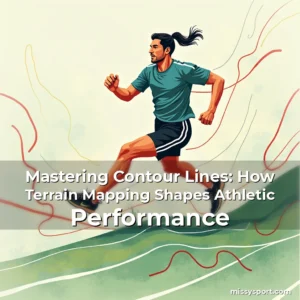

The Art of Contour Lines: Mastering Terrain Visualization in Sports Performance
In the world of athletics, understanding terrain is as crucial as training itself. Whether you’re navigating a mountain trail during a cross-country race or analyzing field conditions before a match, contour lines serve as silent guides that shape every move. These intricate lines reveal the story of the land beneath our feet.
Contour lines are topographic features represented through elevation data, providing athletes and coaches with critical information about the landscape they interact with daily. This knowledge can transform performance outcomes dramatically when applied correctly.
Understanding Contour Lines: A Fundamental Overview
At their core, contour lines represent points of equal elevation on a map. They form closed loops around hills or depressions, helping visualize three-dimensional landscapes on two-dimensional surfaces. Athletes use these maps to plan routes that optimize energy expenditure while minimizing risk.
Each line signifies an increment in height—often measured in meters or feet—allowing users to determine slope steepness by observing how closely spaced the lines appear. Closer spacing indicates steeper inclines, which directly impacts running efficiency and endurance levels.
- Elevation Intervals: Standardized intervals ensure consistency across different maps; common values range from 5m to 50m depending on scale and purpose.
- Spacing Patterns: Wider gaps suggest flatter areas suitable for long-distance runs without significant fatigue accumulation.
How Contour Maps Influence Athletic Training Strategies
Athletic trainers integrate contour mapping into personalized workout regimens to simulate real-world challenges faced during competitions. By replicating various terrains within controlled environments, athletes gain adaptive advantages against unpredictable course layouts.
For instance, runners preparing for hilly races might train specifically on slopes matching those depicted in contour diagrams. This targeted approach enhances muscular strength required for ascending gradients efficiently.
Cross-country skiers utilize similar techniques where snow depth variations affect glide resistance significantly. Accurate representation via contours allows them to adjust technique accordingly based on expected friction changes.
Enhancing Navigation Skills Through Contour Analysis
Navigational prowess becomes essential for outdoor enthusiasts relying solely on physical landmarks combined with digital tools. Contours provide additional layers of context beyond basic GPS coordinates alone.
Detailed analysis helps identify potential hazards such as sudden drop-offs or hidden ravines obscured visually but clearly marked by abrupt shifts in contour patterns. Recognizing these cues early prevents injuries due to misjudged terrain difficulty.
Hikers benefit immensely from mastering contour interpretation skills since it enables safer route selection even under adverse weather conditions where visibility drops drastically.
Case Studies: Real World Applications Of Contour Line Knowledge In Sports
Professional cyclists competing at high altitudes leverage contour charts extensively to strategize pacing strategies effectively. Knowing upcoming climbs ahead gives teams time to conserve energy reserves appropriately.
During the Tour de France, riders analyze stage profiles meticulously using contour-based representations to decide whether attacking aggressively would be beneficial given the road’s undulations.
Similarly, marathon organizers design courses considering both spectator accessibility and athlete safety factors simultaneously guided by thorough contour evaluations beforehand.
These examples highlight how deep comprehension of topographical elements translates directly into competitive edge across diverse sporting disciplines globally.
Technological Advancements Enhancing Contour Mapping Accuracy
LIDAR technology has revolutionized modern cartography enabling precise measurements down to centimeter-level accuracy. This advancement ensures highly reliable contour models used extensively today among elite sportspersons worldwide.
Combined with GIS software platforms capable of overlaying historical climate change effects onto current datasets, planners now predict future environmental alterations affecting event locations accurately.
Satellite imagery further complements ground surveys offering multi-spectral views useful for detecting subtle surface deformations invisible otherwise.
This synergy between traditional methods and cutting-edge tech guarantees up-to-date information guiding strategic decisions made consistently throughout pre-event preparations phases.
Common Misconceptions About Interpreting Contour Diagrams
Many assume that higher density always correlates positively with better conditioning gains regardless of actual gradient differences present. However, this overlooks individual biomechanics influencing optimal training intensities uniquely.
Some mistakenly believe that following every single contour feature improves overall fitness unnecessarily complicating workouts instead of focusing strategically only on relevant aspects matching competition demands precisely.
To avoid confusion, beginners must learn fundamental principles first establishing baseline proficiency gradually advancing towards complex applications later once foundational knowledge solidifies adequately.
Fostering Community Engagement Around Topographical Awareness
Local clubs increasingly host workshops aimed at educating members about reading topographic features properly fostering shared experiences enhancing group cohesion naturally formed around mutual interests.
Online forums dedicated exclusively discussing contour-related topics allow participants exchange tips tricks learning from each other’s successes failures thereby accelerating personal growth collectively benefiting entire communities involved actively.
Collaborative projects involving amateur surveyors working alongside professionals contribute substantially improving regional infrastructure quality indirectly supporting broader societal development goals aligned closely with health promotion initiatives locally implemented successfully everywhere currently.
Conclusion
Mastery over interpreting contour lines equips athletes with indispensable navigational intelligence vital for excelling amidst varied natural obstacles encountered regularly within competitive settings.
By integrating advanced analytical approaches supported continuously evolving technological innovations alongside grassroots educational efforts focused equally on skill acquisition application alike we empower individuals pursue peak performances safely sustainably wherever adventure calls next.